
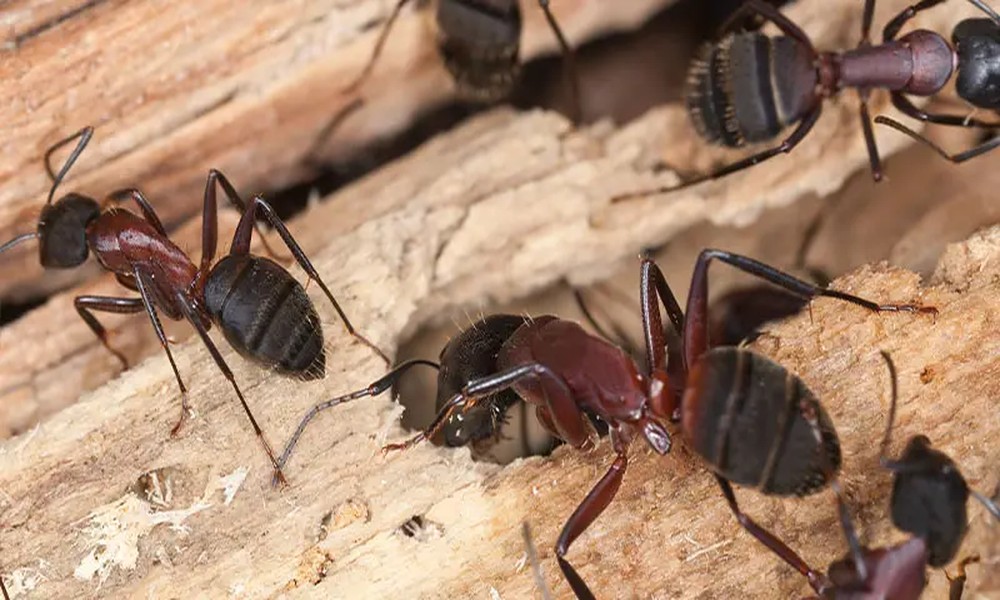
The phone call usually goes one of two ways. Someone found winged insects on a windowsill and is not sure if they are termites or ants. Or someone pulled a piece of trim off and discovered wood that looks chewed, hollowed, or full of sawdust, and is trying to figure out what put it there. Both situations point to wood-destroying insects, and both deserve a quick, accurate answer. Kansas City pest control technicians take these calls year-round, and the most common mistake homeowners make is treating the wrong species. The wrong treatment wastes money. It also gives the actual pest more time to keep working.
Why Misidentification Matters
Carpenter ants and termites both damage wood, but they do it for different reasons, in different patterns, and at different speeds. Termite treatment relies on systems designed for colonies that live in the soil and feed on cellulose. Carpenter ant treatment focuses on the nest itself, since the ants do not eat the wood. They excavate it to build their colony.
A homeowner who applies a termite barrier to a carpenter ant problem will not see the ants go away. A homeowner who treats a termite infestation as if it were an ant problem will see the surface-level activity decline while the real damage continues underneath. The University of Missouri Extension and the National Pest Management Association both publish material confirming the importance of accurate identification before any treatment is selected.
How to Tell the Winged Versions Apart
Both species produce winged reproductive members that swarm in spring. The swarmers are what most homeowners actually see, since the workers stay hidden inside the wood or underground. Three features separate carpenter ant swarmers from termite swarmers.
Body shape. A carpenter ant has a clearly pinched waist, with a narrow segment between the thorax and the abdomen. A termite has a thick, uniform body with no visible waist. The abdomen and thorax appear to blend together.
Antennae. A carpenter ant has bent or elbowed antennae. A termite has straight antennae that look like a string of small beads.
Wings. Carpenter ants have two pairs of wings, with the front pair larger than the back pair. Termites have two pairs of wings of equal size and shape. Termite wings also tend to shed quickly, which is why a pile of small, identical wings on a windowsill is one of the more reliable termite signs.
Color is less useful as a distinguishing feature. Both species are typically dark, though carpenter ants in the Kansas City region can range from black to a reddish brown depending on the exact species.
How the Damage Looks Different
The damage left by carpenter ants and termites is distinct enough that a careful inspection often answers the question without seeing the insects themselves.
Carpenter ant galleries are smooth and clean. The ants chew through the wood and remove the shavings, which creates a polished interior surface that looks almost sanded. The galleries follow the grain of the wood and tend to favor softer, moisture-damaged sections. The shavings the ants discard, called frass, are pushed out of the wood through small openings and often pile up beneath an active gallery. Carpenter ant frass typically contains visible wood shavings along with body parts of dead ants. The mix is distinctive once you have seen it.
Termite galleries look very different. Subterranean termites, which are the species responsible for most Missouri damage, eat the soft spring wood and leave the harder layers intact. The interior of an infested board ends up looking layered, with thin walls of intact wood between hollow chambers. The galleries are often packed with soil and moisture, since the termites bring soil into the wood as they work. There is no clean pile of shavings beneath an active termite gallery, because the termites do not push debris out of the wood the way carpenter ants do.
Frass Versus Mud Tubes
The signs each species leaves outside the wood are also different. Frass below or near a wood surface, often resembling fine sawdust mixed with debris, is a carpenter ant signal.
Mud tubes are a termite signal. Subterranean termites build pencil-width tunnels from soil and saliva to travel between their underground colonies and the wood they are feeding on. The tubes appear on foundation walls, in basements, in crawl spaces, and occasionally on exterior surfaces of the home. A mud tube that rebuilds after being broken open almost always indicates active termite movement.
If you find frass, you are most likely looking at carpenter ants or possibly drywood termites, which are uncommon in this region. If you find mud tubes, you are looking at subterranean termites.
Where Each Species Tends to Show Up in Kansas City Homes
Carpenter ants favor wood that is already softened by moisture. The locations to check first include window frames where seals have failed, door frames where rain water has wicked into the wood, areas around roof leaks or ice dam damage, deck framing where the ledger board meets the house, areas under bathroom fixtures, and the wood around exterior faucets. The ants do not require moisture-damaged wood, but they prefer it because it is easier to excavate.
Subterranean termites enter from below. The most common starting points are basement sill plates, the wood framing around basement windows, crawl space joists, garage door frames where the wood meets the foundation, porch posts that contact the soil, and any place where a piece of wood from the structure makes direct contact with the ground. Termite activity often extends up the foundation behind a hidden mud tube before reaching visible wood.
Why a Professional Inspection Settles the Question
A homeowner with a flashlight can get partway to an answer. A trained inspector goes further. The inspection includes tapping wood to identify hollow sections, moisture readings to find conditions that favor each species, examination of the foundation perimeter for tubes or entry points, evaluation of attic and crawl space framing, and analysis of any frass, wings, or insects collected from the property.
ZipZap Termite & Pest Control has a board-certified entomologist on staff and is a Certified Sentricon Specialist for termites. The same team handles carpenter ant cases regularly across the Kansas City metro. Accurate identification is the first step, and the rest of the work follows from there.
A Faster Answer Than DIY Can Give You
If you have found winged insects, frass, mud tubes, or wood damage of any kind, the cost of an accurate identification is far less than the cost of treating the wrong species. A Kansas City pest control inspection takes less time than most homeowners expect, and it usually resolves the question in a single visit. Reach out to ZipZap Termite & Pest Control to schedule an evaluation if you are not sure what is in your home, and find out what you are dealing with before the damage has time to add up.