
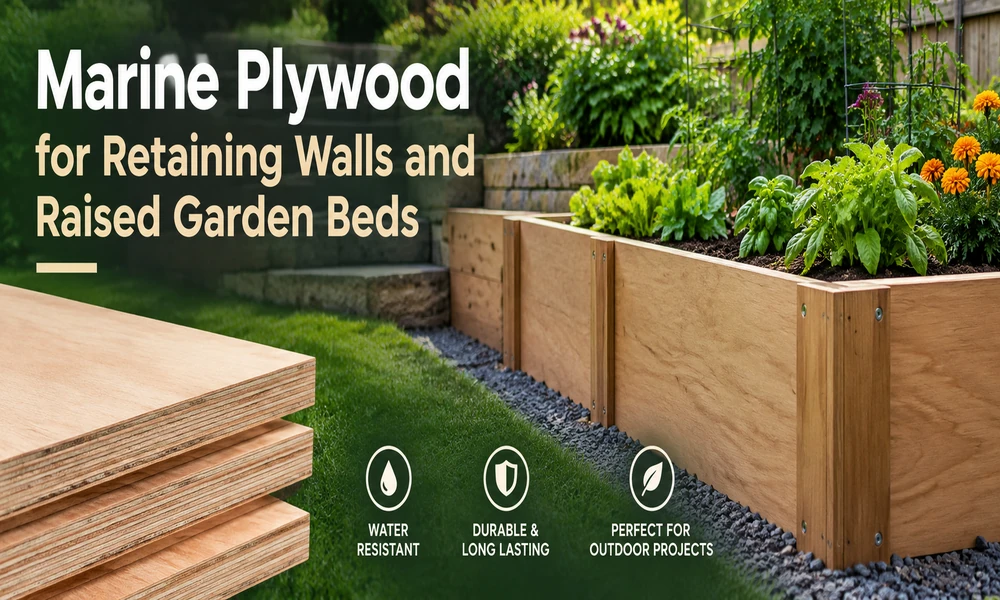
Although retaining walls and raised garden beds may be relatively simple outdoor structures, they are made with materials that will experience a continual combination of moisture and soil contact, as well as variations in weather. Any plywood used for these applications must withstand conditions that interior-grade plywood could not.
Quality Marine Plywood is specifically designed to withstand the conditions of high-moisture environments; it is built with high-quality hardwood veneers and bonded with waterproof phenolic adhesive, and it has a void-free construction. Therefore, Marine Plywood is a good choice for some outdoor structures, but it must still be chosen based on the design and environmental exposure.
Why Marine Plywood Is Good for Areas of High Moisture
Marine Plywood is designed for high-humidity, rain, and constant water-contact environments, and has also been developed for outdoor applications such as exterior buildings and around docks and coastal regions.
In raised garden beds, Marine Plywood’s moisture resistance may be helpful because the material will be placed close to wet soil and possible irrigation water. Plywood in retaining-wall applications may frequently be exposed to damp conditions depending on how the overall structure has been designed. Marine Plywood’s resistance to both swelling and warping from moisture may help prevent it from losing its overall shape while damp; however, the overall structure must be assessed to determine if Marine Plywood is appropriate for the application.
The information we were provided with indicates that all the layers of the marine plywood used to produce the panels will be constructed using high-quality hardwood veneers without any spaces/gaps/holes found between them. This is important with regard to outdoor use because when there are gaps inside the panel, they create an easy way for water and moisture to gain access inside the panel. Creating void-free panels significantly reduces this possibility and increases the structural strength of the plywood whenever it comes in contact with moisture. Because of this, marine plywood is appropriate for extreme use and marine-grade applications rather than being used for in-home and general indoor processes.
Soil & Continual Dampness
Raised garden beds are exposed to damp soil, water (from irrigation systems) and rainfall regularly; therefore, moisture resistance is an important factor in the design of this type of project. Marine Plywood has been engineered to withstand continuous exposure to moisture and is treated for protection against rot, decay and saltwater damage per the document received from the manufacturer.
One thing to note is that marine plywood should not be considered waterproof unless you take care of the exposed edges, joints and cut surfaces when building outdoor structures. The documentation states that marine grade plywood will perform well in moisture conditions but only when finished and maintained properly.
Retaining Walls Are Different Than Raised Garden Beds
While there are similarities between raised garden beds and retaining walls, there are also some very significant differences. The soil pressure and drainage characteristics will determine what types of structural designs will work for your retaining wall. The document provides a description of the structural properties and load-bearing ability that marine plywood provides but does not provide any specific engineering load values or certify the use of marine plywood as a solitary structural system for retaining walls.
Due to the engineering characteristics needed to design a retaining wall, marine plywood should be thought of as a single component within the overall structural design of the retaining wall. The drainage of water immediately adjacent to the structure is of extreme importance because trapped water will build pressure on the retaining structure and may cause catastrophic failure of the structure if it is not addressed. Therefore, when designing a retaining wall, both the structural design and local construction codes will dictate how the structural system is designed.
Selecting Marine Plywood for Garden and Outdoor Structures
When evaluating the use of marine plywood for raised garden beds or outdoor structures, you should begin assessing based upon the quantity of moisture and the length of time it will be exposed to moisture. You should evaluate the grade, certification, thickness, type of veneer construction and the manufacturer’s specifications of the marine plywood. According to the document received, IS 710 is the reference for marine plywood in India.
The thickness of the marine plywood used for the raised garden bed will be dependent upon the size, shape, type of supports needed and the weight of the load being supported. Therefore, thickness does not necessarily mean a better product. Manufacturers like Royale Touche describe their marine plywood by the method of construction, moisture resistance and certifications received before they can be provided as manufacturer’s specifications for use in outdoor applications.
Conclusion
Marine Plywood is manufactured using the following four major properties: High-Quality Hardwood Veneers; Waterproof Glue; Voided-Free; and, Moisture-resistant deterioration properties.
These characteristics make Marine Plywood a candidate for use in constructing raised garden beds and/or components of outdoor structures. However, retaining walls will require additional engineering considerations because soil pressure, drainage, and the structural characteristics of a retaining wall must be determined prior to specifying materials. Although marine plywood can provide a long-lasting and moisture-resistant panel, you should not automatically assume marine plywood is appropriate for your outdoor structures just because of its name.